

Mapping Offshore Talent to Your Business System Blocks for Seamless Workflow Continuity
Business owners, founders, and CEOs often face the same dilemma: you need extra people fast, but you can’t afford to drown in onboarding, alignment, and micromanagement. The solution isn’t to hire more people blindly – it’s to map offshore hires directly onto the blocks that make your business tick, and to build a lightweight operating‑system around that map.
Why Operations & Accountability Must Guide Offshore Hiring
Every department in a profitable company acts as a system block – an input‑output pipeline bounded by clear responsibilities, deliverables, and decision points. When you add an offshore worker, you’re inserting a new entity into that pipeline. If the new stay ambiguous or mis‑aligned, the whole system creaks and cramps.
DSM Talent’s lens sees offshore teams not as standalone labor pools but as plug‑in modules that must dovetail with existing processes. The trick is to map each offshore role to a specific system block and then to enforce a tight feedback loop that guarantees continuous alignment.
The Three‑Phase Mapping Playbook
Below is a repeatable four‑step framework that translates offshore talent into a self‑sustaining operational component.
Step 1 – Identify Your Core Business System Blocks
List the high‑level workflow stages that drive revenue and growth. For most early‑stage tech businesses, that looks like:
Lead Capture & Qualification
Product Development & Delivery
Customer Success & Support
Finance & Operations
Marketing & Growth
Ask every department head: "What is the single most valuable output you produce, and what inputs do you consume?” Capture those in a simple diagram (think Swim‑Lane style, 1‑ on top of 3‑ for example).
Step 2 – Catalog Offshore Role Archetypes per Block
For each block, create a role archetype that fit the competency set you need. Use a four‑column table: Description, Key Deliverables, Primary Metrics, Onboarding Checklist. Example for the Product Development block:
Description: Full‑stack engineer located in a time zone 8 hrs ahead. Key Deliverables: Feature tickets completed within sprint, code quality > review thresholds. Primary Metrics: Feature Cycle Time, bug‑in‑context rate, code‑coverage. Onboarding Checklist: 1. Repo access & branching strategy 2. API docs & authentication keys 3. Demo of current CI/CD pipeline 4. Shadowing a senior dev for 2 days
Remember: the role must be explainable – a founder should answer “Why did we bring this person on?” in under 30 seconds.
Step 3 – Build the Integration Blueprint
With blocks and roles defined, map them as nodes in an integration diagram. For each link, specify:
Entry Criteria – e.g., “Feature ready for dev” triggers assignment to offshore dev.
SLA – turnaround time for that interaction.
Communication Mode – e.g., Slack channel, JIRA issue, stand‑up call.
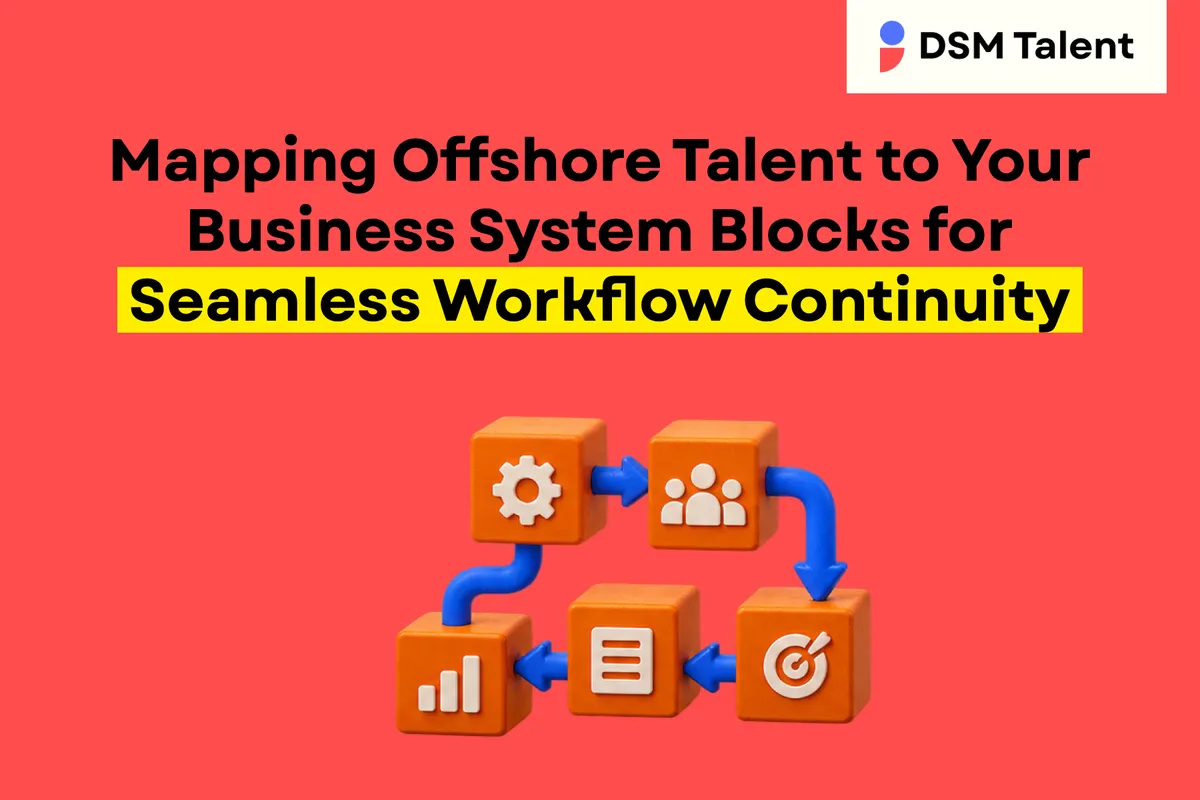
Turn the diagram into a one‑page SOP sheet that sits in each onboarding packet and in your team's shared drive. Use a visual template: block icons connected by arrows, color‑coded by status (green OK, yellow warning, red critical).
Step 4 – Continuous Alignment Sprint
This isn’t a one‑time check‑in; it’s a recurring rhythm:
Weekly Alignment Review: 30‑min video call. Role lead (offshore or onshore) presents progress against metrics. Founder or product owner throws in the “high‑level priorities” map.
OKR Sync: Align each offshore role’s objectives with the team’s OKRs using a quick RACI‑S (Responsibility, Accountability, Consulted, Informed – plus Success).
Metric Dashboard Refresh: Dashboard (Google Data Studio, Power BI, or a shared Google Sheet) auto‑updates every day with cycle times, bug counts, and engagement scores. Founder reviews weekly, not daily.
Feedback Loop: A brief 5‑minute sprint demo where offshore hires show code or deliverables. Onshore team gives “Right‑now” feedback (80‑20 rule: 80% praise, 20% constructive).
By embedding these rituals, you convert offshore work into a predictable, low‑friction process that can be replicated as you grow.
Operational KPIs to Watch
Time‑to‑Value (TTV) per ticket – how long from handoff to feature release.
Turn‑around compliance – % of tasks finished within SLA.
Alignment Score – derived from survey responses “Do you understand how your work impacts the next block?” scaled 0‑5.
Cost‑per‑Outcome – spend divided by value added (e.g., $ per feature shipped).
When these numbers hover in the green, you’re trusting offshore talent as a scalable system component; when they drift yellow or red, fall back to a rapid corrective loop.
Tactical Tips for Founders
Start Small: Pick one block (e.g., QA) and one role (e.g., test engineer). Nail the map before expanding.
Owner‑In‑Depth: Assign an onsite owner to champion the offshore role. That owner becomes the single point of escalation.
Temporal Sync: Use a shared calendar that flips the time zone difference into a productive overlap window (e.g., 2‑3 AM local time for the offshore team, 2‑3 PM for you). Keep important meetings in that window.
Transparent Spend: Hold a quarterly budget review that correlates spend with output metrics. This turns hiring dollars into measurable ROI.
Conclusion – Turning Offshoring Into a Predictable Engine
By mapping offshore talent onto your business system blocks, you eliminate the guesswork that usually accompanies remote hiring. The result?
Clear accountability—every task has a named owner.
Predictable lead times—SLA’s are verified by metrics, not anecdotes.
Scalable rhythm—add roles with the same blueprint, keep founder focus on strategy.
Implement the playbook now, and watch offshore work become an operational lever that drives, rather than hinders, growth.
Take‑Away for Today
Draft your Business System Blocks map. 5 minutes.
Pick one block, define a role archetype. 10 minutes.
Build a single‑page SOP for the role. 15 minutes.
Schedule a weekly 30‑min alignment call. 5 minutes.
Done. Your offshore workforce is now a repeatable, measurable, and controllable component of your operating system.
Plan your next step with DSM Talent
Ready to discuss the right offshore roles for your business? Explore offshore hiring with DSM Talent and start with the roles, expectations, and support your business needs.


